Special
MRI Whole Body
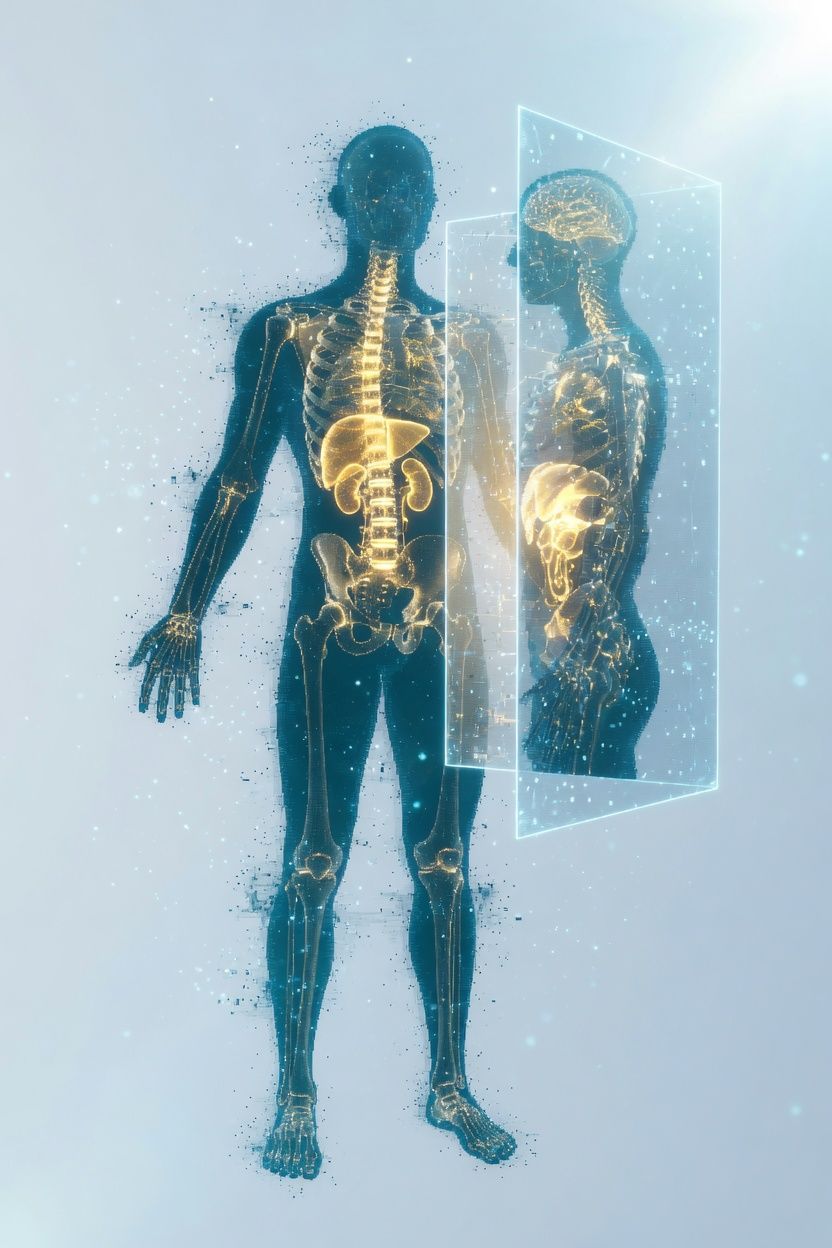
Head, neck, chest, abdomen and skeleton in a single session: whole-body MRI for systemic questions, for example inflammatory or tumorous conditions. The examination is also suitable for individual health screening.
Top- Examination time (min)
- 45–70
- Report turnaround (days)
- 1–3
Who it is for
TopFor patients with known cancer or systemic disease, such as myeloma or metastases, to assess extent and course, and for unclear general symptoms; as an examination without a specific reason only after detailed information about incidental findings and limitations – MRI Whole Body in Frankfurt.
When
- Suspected tumor or inflammation in the trunk
- Individual health screening or as a contribution to assessing your state of health
- Search for metastases in known cancer or follow-up of known metastases during treatment
- Evaluation of unclear general symptoms (e.g., weight loss) – here the method can make a valuable contribution and identify and potentially classify patterns of findings
- Assessment of the course and extent of a known systemic disease (for example, a rheumatic disease)
When not
- Methodological limitations apply, among others, to questions about pulmonary nodules and suspected kidney stones.
- For specific questions concerning individual organs (e.g., heart, prostate, and breast), there are separate, tailored examination protocols. These cannot be integrated into a whole-body MRI examination.
- Implant that is not MRI-compatible (e.g., pacemaker)
What the images show
Top- T1 and T2 or STIR of the spine and pelvis: bone marrow
- DWI: highly cellular lesions, key in myeloma
- Organ series at lower resolution than a targeted MRI
- Contrast agent only if the clinical question requires it, not as part of every check-up
Course
TopArrival
Registration and clarification of whether there is an oncological question or a check-up. This changes the protocol.
Briefing
Time lying in the scanner, noise, the possibility of incidental findings and any follow-up examinations that may result.
Positioning
Supine position, coil change or sliding table depending on the scanner.
Examination
Usually about 45–70 minutes, depending on the protocol.
Conversation
The images are presented to you after the examination, and the findings are discussed calmly with you.
Written report
Complete written report usually 1–3 days after the examination, depending on the urgency and complexity of the case.
Time at the practice
Approximately 1 to 1.5 hours
Preparation
Top- No special bowel preparation (e.g., laxative measures) is required.
- Bring your implant card, if available
- Reports on prior examinations and pre-existing conditions are important and should be brought to the examination
Report
TopFor each region, the findings regarding the clinical question; separately, incidental findings with a specific consequence: none, follow-up, or targeted further examination.
How to read it
In myeloma according to MY-RADS, not as free prose. In a check-up without a specific reason, an unremarkable report does not give the all-clear for organs that the protocol visualizes poorly.
Reported by Dr. Christopher Behrens or Dr. Manuel Schloß.
Limit
Top- Resolution and contrast are in part lower than in a targeted MRI. The examination provides a good overview of the organs of the chest, abdomen, and skeletal system, but does not replace a detailed examination for a specific organ-related question.
- Incidental findings are common (for example, during a screening examination) and may require targeted follow-up examinations/checks.
- Questions about diseases of the lungs, the coronary arteries, and the mucosa of the stomach and bowel are not a domain of MRI. The method can be used in addition to, for example, a colonoscopy, but does not replace it.
Sources
Top- GuidelineMessiou C et al.,. MY-RADS Guidelines for Acquisition, Interpretation, and Reporting of Whole-Body MRI in Myeloma. Radiology 2019;291:5-13. 2019.
- Paper on the next stepSchmidt GP, Dinter D, Reiser MF, Schoenberg SO. Possibilities and limitations of whole-body MRI. Dtsch Arztebl Int 2010;107:383-389. 2010.
Questions
Top- How long does it take?
- Usually 45–70 minutes, depending on whether an oncological or an overview protocol is used.
- Is contrast needed?
- Usually not for the check-up. For a tumor question, only if the protocol requires it.
- Do I need a referral?
- No statutory health insurance referral. For the oncological indication, the request from the treating practice; for the check-up, your own decision after information about incidental findings.
- When does the report arrive?
- The complete written report is usually available within 1–3 business days.
Appointment
TopWhat to bring
- Reports on prior examinations and pre-existing conditions are important and should be brought to the examination
- Bring your medication plan
- Implant card, if available