MRI-guided
MRI-guided Pain Therapy
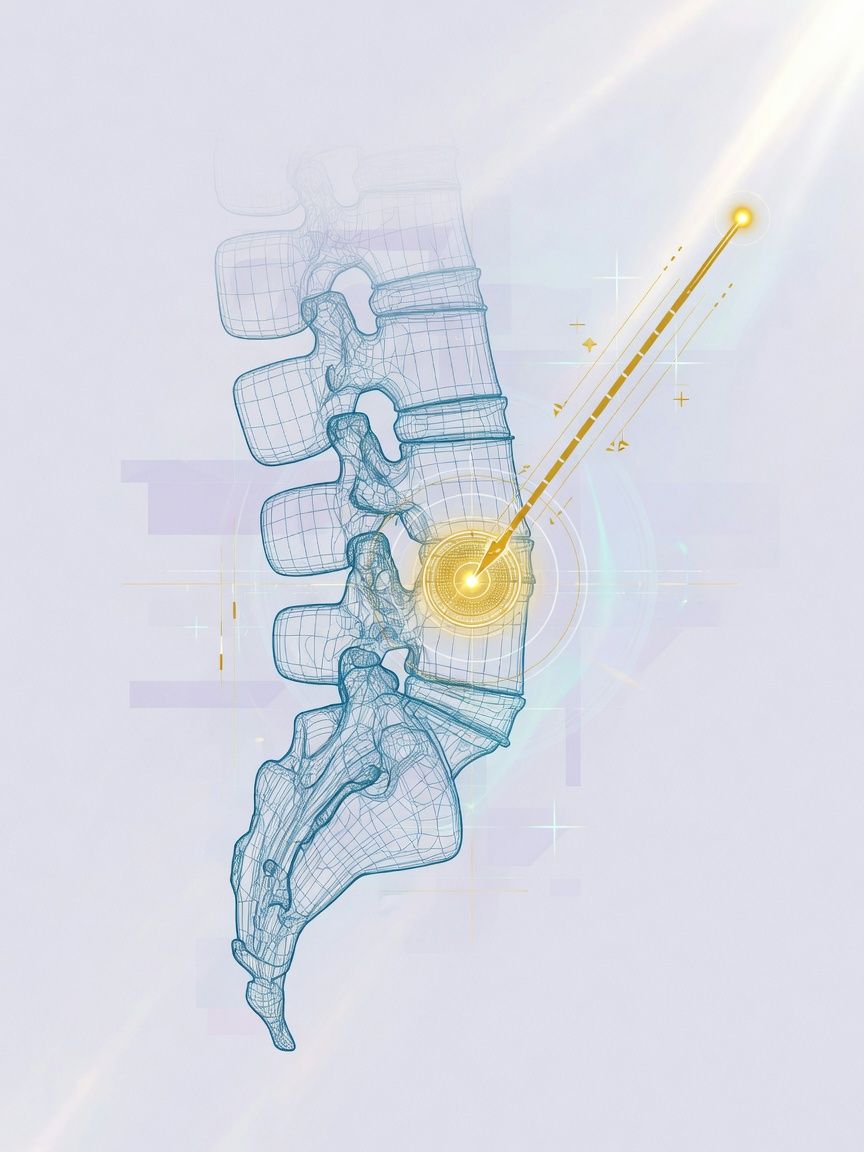
Acute or chronic pain originating from the intervertebral disc or facet joint: in MRI-guided pain therapy ("PRT," "facet therapy"), the medication is applied directly at the target site, minimally invasively and without radiation. Outpatient and low-risk.
Top- Examination time (min)
- 20–30
- Report turnaround (days)
- 1–3
Who it is for
TopFor patients with local pain or pain radiating into the arm or leg due to a disc herniation or disc bulge, or with irritation of the small vertebral joints (facet joints), when appropriate MRI findings are available – MRI-guided pain therapy in Frankfurt.
When
- Local pain or pain radiating into the legs/arms due to a disc herniation or disc bulge.
- Acute or chronic irritation of the facet joints ("lumbago").
When not
- Acute disc herniation with paralysis, bladder or bowel dysfunction, acute infection, known severe coagulation disorder
- Allergy to the planned medication
- Unclear cause of symptoms – appropriate MRI diagnostics should be performed first.
- Expectation of a guaranteed, permanent elimination of the cause. The injection treats the symptoms, not the disc damage
What the images show
Top- Planning sequence of the target region: level, side, access
- Needle guidance in an open or closed-bore architecture, depending on the scanner. On a closed-bore 1.5 Tesla system, access is limited and not every target is suitable
- Control image after injection, if a visible agent is used
Course
TopArrival
Registration, coagulation status, allergies, current imaging of the region.
Briefing
Written informed consent regarding infection, bleeding, temporary increase in pain, and the limitations of the procedure.
Positioning
Prone or lateral position, sterile draping, target region within the coil window.
Examination
The guidance itself takes less time than a diagnostic MRI. With positioning and observation, a separate appointment is required.
Conversation
Immediately afterwards: what was injected, which physical activities to avoid today, and when an effect can be expected.
Written report
Brief procedure report with level, side, medication, and dose.
Time at the practice
Plan for the time including post-procedure observation, not just the time in the scanner.
Preparation
Top- Stop anticoagulant medications (e.g., "Marcumar") only after consultation.
- Bring current MRI or CT of the region, if available
- If applicable, an accompanying person; after procedures near the nerve root ("PRT"), you may not drive a car or ride a motorcycle yourself
Report
TopTarget structure, level, side, medication, dose, special aspects of access, recommendation regarding physical activity.
How to read it
Improvement suggests that the anesthetized structure was involved. It does not prove that surgery is unnecessary, and the absence of improvement does not prove the opposite.
Reported by Dr. Christopher Behrens or Dr. Manuel Schloß.
Limit
Top- On a closed-bore high-field scanner, MRI-guided treatment is not possible or appropriate for every target. Which injections can be performed on site should be discussed in detail with the practice team before the procedure.
- Depending on the specific findings or cause of the symptoms, a neurological/neurosurgical consultation should take place – symptomatic pain treatment should not delay a possible treatment of the underlying cause.
- Unfortunately, there is no guarantee of (lasting) improvement of symptoms.
Sources
Top- GuidelineBundesärztekammer, KBV, AWMF. German National Disease Management Guideline on Non-Specific Low Back Pain. 2. Auflage, Empfehlung gegen frühe Bildgebung ohne Warnzeichen und gegen Injektionen beim nicht-spezifischen Kreuzschmerz. 2017.
- Paper on the next stepFritz J, Niemeyer T, Clasen S et al.. Management of chronic low back pain: rationales, principles, and targets of imaging-guided spinal injections. Radiographics 2007;27:1751-1771. 2007.
Questions
Top- How long does it take?
- The guidance takes less time than a diagnostic examination. With informed consent and post-procedure observation, it requires a separate appointment.
- Is contrast needed?
- A visible agent may be used to check needle position. A diagnostic contrast agent as used in organ MRI is not the purpose.
- Do I need a referral?
- No statutory health insurance referral. A prerequisite is appropriate clinical and imaging findings, not merely a patient request.
- When does the report arrive?
- You and your referring practice usually receive the brief written procedure report after 1–3 business days.
Appointment
TopWhat to bring
- Current MRI or CT of the region
- List of medications, especially anticoagulants
- An accompanying person